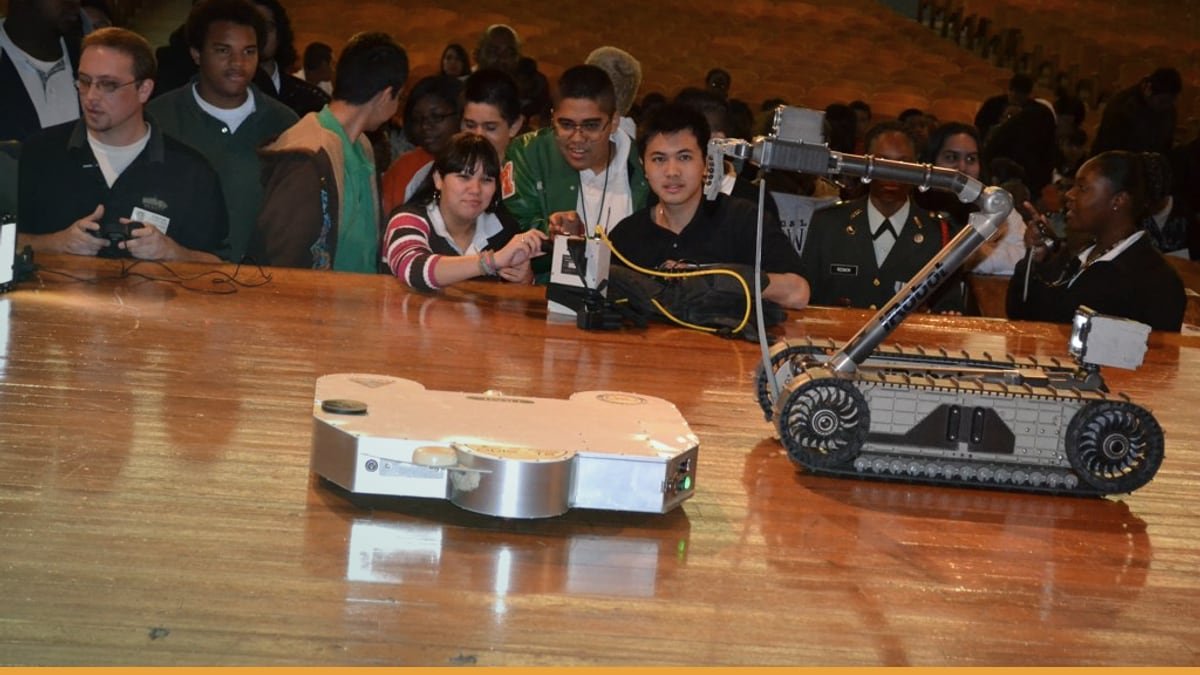
Header image: Army reaches out to San Antonio youth (5324773312).jpg) by U.S. Army RDECOM from Aberdeen Proving Ground, MD, USA, Public domain, via Wikimedia Commons — cropped to 16:9 and colour-adjusted.
Key takeaways
- Industry is merging engineering theory with technology implementation
- AI augments both engineering and technology roles
- Hybrid skills will dominate future technical careers
Engineering and engineering technology are not the same. Full stop.
Engineering is theoretical design, advanced maths, the pursuit of what’s possible. Engineering technology is hands-on implementation, applied skills, making those designs work in the real world. The American Society for Engineering Education (ASEE) draws a hard line: distinct disciplines, separate career paths. Engineering graduates are "engineers. " Engineering technology graduates are "technologists. " That’s the academic divide.
But industry? Industry doesn’t care.
Companies like L&T Technology Services (LTTS) and Imperial Auto are operating in ways that bridge engineering and technology. They’re fusing AI, automation, and global R&D centres to create roles that demand both—deep theoretical knowledge and practical mastery. The distinction still exists on paper. In practice? It’s dissolving.
The Academic Divide: Maths, Science, and the Curriculum Gap
The difference between engineering and engineering technology is starkest in the classroom.
Engineering programmes are theory-heavy. Rowan University’s comparison lays it out: more advanced applied science and mathematics—calculus III, differential equations, thermodynamics. Engineering technology programmes? Often capped at calculus I. The focus is on applying existing tools, not inventing new ones.
Michigan Technological University (MTU) puts it bluntly: engineering technology graduates are "masters of technology. " They gain a "broad and deep understanding of the processes, systems, tools, and techniques necessary to construct, modify, operate, and maintain an engineering design. " The key word? Operate. Engineering technology is about making things work, not just designing them.
The University of Kentucky’s College of Engineering is even clearer: "One size does not fit all. " Some students thrive in the abstract, theory-driven world of engineering. Others excel in the hands-on, problem-solving environment of engineering technology. The curricula reflect that divide. Engineering programs focus on advanced theoretical concepts while Engineering Technology programs focus on practical application. Engineering programs emphasize advanced science while Engineering Technology programs emphasize practical implementation.
This divide makes sense—on paper. But the real world doesn’t separate design from implementation. A civil engineer who can’t read a blueprint is useless. A manufacturing technologist who doesn’t understand material science is limited. The question isn’t whether one is "better" than the other. It’s whether the academic distinction still serves students—or employers.
Career Paths: Where the Degrees Actually Lead
On paper, the career paths for engineers and technologists look different.
Engineering graduates land in design, R&D, theoretical problem-solving—think aerospace, civil, software. Engineering technology graduates, per MTU, end up in manufacturing, construction, product improvement, system optimisation.
But here’s the twist: the job titles don’t match the distinction.
MTU admits it outright: "The degree is engineering technology, but the career is engineering. " Walk into a manufacturing plant. You’ll find "engineers" who graduated from engineering technology programmes. The ASEE’s Engineering Technology Council even lists engineering technology as a career in engineering. So much for clarity.
This labelling problem creates friction. Technologists hit ceilings in roles requiring an "engineer" title, even if their skills are equivalent. Employers miss talent because they filter for degrees, not capabilities. The gatekeeping is subtle but real: a technologist with a decade of hands-on experience might be passed over for a design role requiring a "real" engineering degree—even if the job is 80% implementation.
That’s a missed opportunity. If a technologist can troubleshoot a complex manufacturing system, does it matter whether they took calculus III? In some industries, absolutely. In others? Not at all.
The Blurring Lines: How Industry Is Merging the Two
While academia clings to the distinction, industry is already moving past it. Two recent developments prove it:
- **LTTS’s partnership with Cognite (September 24, 2026). LTTS brings deep engineering expertise. Cognite brings AI-native industrial solutions. The goal? A hybrid model where AI augments—but doesn’t replace—engineering knowledge.
- Imperial Auto’s Global Technology Center in Germany. The centre bridges European customer requirements and Imperial Auto’s global engineering and manufacturing operations. It’s not just design or implementation. It’s integration—translating local needs into global solutions, and vice versa.
These aren’t incremental changes. They’re a fundamental shift.
LTTS isn’t just slapping AI onto engineering. It’s redefining what "engineering intelligence" means. Imperial Auto isn’t just opening a satellite office. It’s creating a hub where theoretical engineering meets real-world application. In both cases, the old divide between engineering and engineering technology is becoming irrelevant.
The hybrid role is here. Companies want professionals who can:
- Understand the theoretical underpinnings of a design (engineering).
- Implement it efficiently using the latest tools (engineering technology).
- Use AI and automation to iterate faster (the new wildcard).
This isn’t a merger of disciplines. It’s an expansion. The question isn’t whether engineering and engineering technology will become the same. It’s whether the distinction will matter at all in five years.
The AI Factor: Why Technology Is Reshaping Engineering
AI is the accelerant in this equation.
LTTS’s partnership with Cognite isn’t about replacing engineers with algorithms. It’s about using AI to enhance engineering intelligence. The Free Press Journal describes it as combining "deep engineering expertise with AI-native industrial experiences. " Translation: AI handles the repetitive, data-heavy tasks—simulations, predictive maintenance, optimisation—while engineers focus on creative problem-solving and oversight.
Here’s what that looks like in practice:
- For engineers: AI tools run thousands of design simulations in the time it takes a human to run one. That doesn’t eliminate the need for engineering judgment. It amplifies it.
- For technologists: AI predicts equipment failures before they happen. But someone still needs to understand the underlying mechanics to fix them. That’s where hands-on expertise comes in.
The risk? Over-reliance. If engineers treat AI as a crutch, they might lose the ability to spot flaws in its outputs. If technologists rely too heavily on automation, they might struggle when systems fail. The sweet spot? A professional who understands both the why (engineering) and the how (engineering technology)—and knows when to trust AI and when to question it.
This is the future. AI won’t replace engineers or technologists. It will force them to evolve. The most valuable professionals won’t be the ones who can do one thing well. They’ll be the ones who can do both.
The Skills Gap: What Employers Really Want
The blurring lines between engineering and engineering technology are exposing a skills gap.
Traditional engineering firms still prioritise advanced maths and theoretical design. Manufacturing and tech-driven industries? They’re hungry for applied skills—rapid prototyping, tool proficiency, real-world problem-solving.
Imperial Auto’s Germany centre demonstrates this integration.** It’s not just about engineering or technology. It’s about bridging the two. The centre’s role? To "support engineering capabilities" while enabling "faster technical responses" to European customers. That requires engineers who can design globally but adapt locally. And technologists who can implement those designs efficiently.
The emerging trend is clear: employers want professionals who can straddle both worlds. A job posting for a hybrid engineering role might require:
- A four-year engineering degree (theory).
- Experience with CAD and rapid prototyping (application).
- Familiarity with AI tools (the new wildcard).
This isn’t a niche demand. LTTS’s partnership with Cognite proves even large-scale industrial operations are moving in this direction. The question isn’t whether this hybrid skillset is valuable. It’s whether universities and training programmes are keeping up.
The Education Dilemma: Are Universities Keeping Up?
Right now? No.
Most universities still treat engineering and engineering technology as separate tracks. The ASEE’s stance is clear: distinct disciplines, distinct career paths. But that model is increasingly out of step with industry demands.
Here’s the problem:
- Engineering programmes are theory-heavy but often lack hands-on implementation training.
- Engineering technology programmes teach practical skills but may skimp on advanced maths and science.
- Neither explicitly teaches how to integrate AI and automation into traditional workflows.
The opportunity? Universities could offer hybrid programmes that bridge the gap. Imagine a curriculum that:
- Teaches advanced engineering theory and applied implementation.
- Includes AI and automation as core components, not electives.
- Offers real-world projects where students solve problems using both engineering and technology skills.
The student choice is tricky. Should undergrads specialise early, or seek a broad foundation with electives in both? Right now, most are forced to choose—and that choice can limit their career flexibility.
The best path? A broad foundation with targeted electives. A mechanical engineering student who takes courses in manufacturing processes and AI tools will be far more adaptable than one who doesn’t.
The bigger question: Will universities adapt, or will industry leave them behind? Companies like LTTS and Imperial Auto are already creating their own hybrid roles. If academia doesn’t catch up, students might find themselves unprepared for the jobs of the future.
The Future: Will the Distinction Disappear?
In the short term? No.
Engineering and engineering technology will remain distinct disciplines, at least on paper. The academic divide is too entrenched to disappear overnight. But in practice? The lines are already blurring.
Here’s what will happen:
- Short-term (next 5 years): The distinction will persist, but hybrid roles will become more common. Employers will start valuing skills over degrees. Technologists will gain more recognition in "engineering" roles.
- Long-term (10+ years): AI and automation will merge engineering and engineering technology into a spectrum of "technical problem-solvers. " The label—engineer vs. technologist—will matter less than the ability to design and implement solutions.
The most successful professionals will be the ones who can straddle both worlds. Deep technical knowledge and hands-on adaptability. Theoretical rigour and practical mastery. The ability to design a system and troubleshoot it when it fails.
The real question isn’t whether the distinction will disappear. It’s whether academia will keep up—or whether industry will redefine the rules without them.
What This Means for Students, Professionals, and Employers
For Students:
- Choose based on your strengths. If you love maths and theory, engineering is a natural fit. If you prefer hands-on problem-solving, engineering technology might be better.
- But don’t silo yourself. Take electives in AI, automation, and the "other" discipline. The more adaptable you are, the more valuable you’ll be.
- Plan to upskill. The job you train for today might not exist in 10 years. Build a foundation that lets you pivot.
For Professionals:
- Engineers: Learn practical implementation. Take a course in manufacturing processes, CAD, or rapid prototyping. The more you understand the "how," the better you’ll design for it.
- Technologists: Strengthen your theoretical foundations. Brush up on advanced maths and science. The more you understand the "why," the better you’ll troubleshoot problems.
- Both: Get comfortable with AI and automation. These tools aren’t going away. They’re becoming essential.
For Employers:
- Stop gatekeeping job titles. A "technologist" with AI expertise might outperform a traditional engineer in tech-driven roles. Focus on skills, not degrees.
- Redefine roles. The hybrid model is already here. Start creating job descriptions that reflect it—roles that demand both engineering theory and practical implementation.
- Invest in training. If universities aren’t keeping up, it’s on you to fill the gap. Offer upskilling programmes in AI, automation, and cross-disciplinary collaboration.
The call to action? Universities, companies, and professionals need to collaborate. Define new hybrid roles. Create curricula that reflect them. Build career paths that reward adaptability. The distinction between engineering and engineering technology isn’t going away. But it’s becoming less important than the ability to merge the two.
The open question: Will industry lead the way, or will academia finally catch up?
Sources
- Engineering vs Engineering Technology
- Engineering vs. Engineering Technology
- Engineering vs. Engineering Technology
- Engineering vs. Engineering Technology: What Are the …
- L&T Technology Services Partners With Cognite To Advance Engineering Intelligence With Industrial AI
- Imperial Auto opens Global Technology Center in Germany to support engineering capabilities