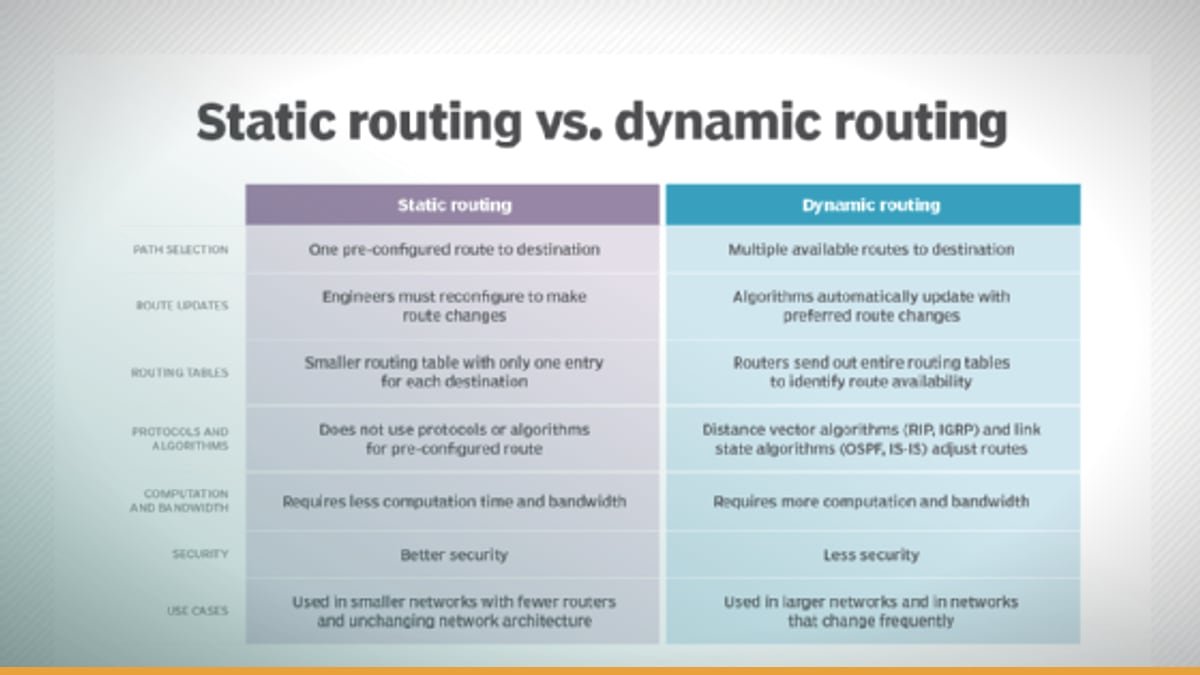
Header image source: Static Vs. Dynamic Routing: What is the Difference? via TechTarget via Google — cropped to 16:9 and colour-adjusted.
Key takeaways
- PoLar dynamically skips or repeats transformer layers per input
- Higher accuracy with fewer layers on GSM8K and MATH
- Prediction network mimics brain’s thalamus for dynamic routing
PoLar just landed. And it’s not incremental.
For years we’ve treated transformer layers like a factory assembly line—every input, from "What’s 2+2? " to "Prove Fermat’s Last Theorem," marches through the same 24 or 48 or 96 layers, no exceptions. That rigidity ends now. Program-of-Layers (PoLar) adds a lightweight prediction network that generates bespoke execution programs per input, dynamically skipping or repeating layers based on difficulty. The upshot? Higher accuracy with fewer layers, and a glimpse of how LLMs might actually "think" more like brains than we ever expected.
This isn’t just an efficiency hack. It’s a fundamental rethink of inference architecture.
The Problem: Fixed-Depth Inference Wastes Latent Capacity
Standard LLM inference is rigid. Every input—whether trivial or tortuous—gets processed through the exact same sequence of transformer layers. No detours, no shortcuts. This fixed-depth execution is hard-wired into training and deployment, yet it ignores a basic truth: not all inputs need the same computational horsepower.
The numbers tell the story. On GSM8K and MATH, PoLar’s experiments show that most inputs hit the same or better accuracy with fewer layers than the full model depth. Some inputs even see higher accuracy when routed through alternative sequences that skip or repeat blocks. That’s not just efficiency—it’s evidence that fixed-depth inference leaves performance on the table.
Here’s the kicker. The paper calls fixed-depth execution a "narrow subset" of an LLM’s latent computational paths. Think about that. We’ve treated these models as monolithic black boxes, assuming the forward pass is the only way they can reason. But PoLar proves that’s false. There are other paths—latent routes through the layers—that can solve problems better, faster, or both.
Why does this matter? Because the brain doesn’t work like a fixed assembly line. It dynamically allocates resources. Visual cortex for images, prefrontal cortex for planning, thalamus as gatekeeper routing signals between them. Fixed-depth inference is the opposite. It’s like forcing every thought through the same neural pathway, whether it’s a reflex or a deep analysis.
PoLar’s Core Innovation: Dynamic Layer Routing via Programs
PoLar’s approach is simple in concept, radical in execution. Instead of a fixed layer sequence, each input gets its own execution program—a customised sequence of skips, repeats, or both. The heavy lifting happens in the prediction network, a lightweight module trained to generate these programs on the fly.
Let’s break it down:
- Skipping: Bypass contiguous blocks when the input is simple. If the model can answer "What’s the capital of France? " in 12 layers instead of 24, why burn cycles on the rest?
- Repeating: Revisit the same block multiple times for harder inputs. This mirrors how the brain iteratively refines signals—like rereading a tricky paragraph to parse its meaning.
- Combined: Mix both strategies in a single program. Some inputs might skip early layers (basic tokenisation) but repeat later ones (reasoning).
The experiments are unambiguous. Repeating outperforms skipping. Combining both outperforms either alone. On GSM8K, PoLar’s best programs achieve higher accuracy than the standard forward pass while using fewer layers on average. That’s not just a win—it’s a paradigm shift.
But here’s what’s really interesting. PoLar treats layers like specialised cortical areas. Some inputs need only a subset (early layers for syntax, mid-layers for semantics), while others require iterative refinement (late layers for multi-step reasoning). This isn’t just a metaphor. The paper explicitly draws inspiration from the brain’s thalamo-cortical routing, where the thalamus dynamically gates information flow between cortical regions based on task demands.
In PoLar, the prediction network acts like the thalamus. It decides which "cortical areas" (layers) to engage for each input, and in what order. That’s not just clever optimisation—it’s a biologically plausible model of how LLMs might actually organise computation.
Performance Gains: Fewer Layers, Higher Accuracy
The numbers are stark. On GSM8K, PoLar’s best execution programs achieve higher accuracy than the standard forward pass while using fewer layers on average. On MATH, the improvement is even more pronounced—some inputs see better accuracy with significantly fewer layers than the standard pass.
But it’s not just about efficiency. PoLar corrects errors that the standard forward pass gets wrong. In many cases, an alternative program—often with fewer layers—produces the correct answer where the fixed-depth model fails. That suggests LLMs have redundant or parallel computational capacities. The standard forward pass isn’t always the best path; sometimes, a detour through the layers is more effective.
This complicates explainability. If LLMs can solve problems via multiple valid reasoning paths, how do we interpret their decisions? And if they choose a suboptimal path, can we nudge them toward a better one? PoLar opens these questions. It’s not just about making models faster—it’s about making them smarter by unlocking latent computational paths that fixed-depth inference misses.
The Brain Analogy: Thalamo-Cortical Routing in LLMs
PoLar’s design isn’t just inspired by neuroscience—it’s a direct analogue of how the brain routes information. The paper draws a clear parallel between transformer layers and cortical areas, and between PoLar’s prediction network and the thalamus.
Here’s the comparison:
- Brain: The thalamus dynamically routes signals between cortical areas based on task demands. Visual tasks engage the visual cortex, planning tasks engage the prefrontal cortex. The thalamus acts as a gatekeeper, deciding which areas to prioritise.
- PoLar: The prediction network dynamically routes inputs through transformer layers based on input difficulty. Simple inputs might skip early layers, complex ones might repeat late layers. The prediction network acts like the thalamus, deciding which "cortical areas" (layers) to engage.
This isn’t just a cute analogy. The paper argues that PoLar’s success supports the idea that transformer layers do specialise like cortical regions. Early layers might handle low-level features (syntax), mid-layers semantic understanding, late layers reasoning and planning. Dynamic routing isn’t just an optimisation—it’s a step toward brain-like computation in LLMs.
But is this more than a metaphor? Could PoLar’s routing actually reflect how LLMs internally organise information? The evidence is suggestive. If layers specialise like cortical areas, then dynamic routing isn’t just a hack—it’s a fundamental part of how these models should work.
Latent Computational Paths: What Fixed-Depth Inference Misses
Pretrained LLMs contain useful computational paths beyond their standard forward passes. PoLar proves this. Alternative programs can correct errors made by the fixed-depth model, often with fewer layers. That’s not just a performance boost—it’s evidence that LLMs have latent reasoning capacities we’ve been ignoring.
Here’s the implication. Fixed-depth inference is like reading a book cover-to-cover every time, even if you only need a single chapter. PoLar shows that sometimes you can skip to the relevant section—or even reread it—to get a better answer. The standard forward pass is just one way to navigate the model’s knowledge. There are others.
This complicates interpretability. If an LLM can arrive at the same answer via multiple paths, how do we explain its decisions? And if it chooses a suboptimal path, can we steer it toward a better one? PoLar suggests that debugging LLMs might involve not just analysing weights, but analysing the paths they take through their own layers.
It also raises a deeper question. If LLMs have latent computational paths, why haven’t they learned to use them during pretraining? Is dynamic routing a missing ingredient in how we train these models, or is it something that emerges naturally when we give them the right tools?
Limitations and Open Questions
PoLar isn’t a silver bullet. The prediction network adds minimal overhead—the paper calls it "lightweight"—but it’s still an additional learned component. That means more moving parts, more potential for overfitting, and more complexity in deployment.
Here are the big unresolved questions:
- Generalisation: Does PoLar’s routing generalise to unseen tasks? The experiments focus on mathematical reasoning, but what about creative writing, code generation, or multimodal tasks? Can the prediction network adapt to new domains without retraining?
- Layer Specialisation: Are some layers intrinsically better suited for skipping or repeating, or is this purely input-dependent? The paper suggests early layers are often skipped for simple inputs, late layers repeated for complex ones. But is this learned behaviour, or a fundamental property of transformers?
- Scaling: How does PoLar behave in very large models (100B+ parameters)? The experiments use models up to 7B parameters, but scaling dynamic routing to larger architectures might introduce new challenges. Will the prediction network need to grow? Will overhead become prohibitive?
- Training vs. Inference: PoLar is a post-hoc optimisation—applied after pretraining. But what if we trained models with dynamic routing from the start? Would they develop different layer specialisations? Would they be more efficient, or would they overfit to the routing mechanism?
The biggest question of all: if dynamic routing is so effective, why haven’t LLMs evolved this way naturally? Is it a missing ingredient in pretraining, or does it require explicit design?
Future Directions: From PoLar to Adaptive-Layer Architectures
PoLar is just the beginning. If dynamic routing works for transformer layers, it could work for any modular architecture. Here’s where this could go next:
- Hierarchical Routing: PoLar treats layers as monolithic blocks, but what if we extended it to groups of layers? Vision modules for image-like data, reasoning modules for logic, memory modules for long-context tasks. The prediction network could route inputs through specialised sub-networks, not just individual layers.
- Neurosymbolic Hybrids: Could PoLar’s routing enable tighter integration with symbolic reasoning? Skip layers for formal logic (where symbolic solvers excel), repeat layers for fuzzy reasoning (where neural networks shine). This could bridge neural and symbolic AI.
- If dynamic routing reduces the need for ever-larger models, it could shift the focus from scaling model size to optimizing routing strategies. Imagine a smaller model with dynamic routing outperforming a much larger model with fixed-depth inference. That’s not just performance—it’s sustainability.
- Beyond Transformers: PoLar is designed for transformers, but dynamic routing could apply to diffusion models, RNNs, or hybrid architectures. What if Stable Diffusion could dynamically skip or repeat denoising steps based on image complexity?
The endgame? Fully adaptive LLM architectures, where layers are dynamically allocated like compute resources in a data centre. Instead of a fixed assembly line, we’d have a flexible network that reconfigures itself on the fly based on task demands.
The open question remains: if dynamic routing is so effective, why haven’t LLMs evolved this way naturally? Is it a missing ingredient in pretraining, or does it require explicit design? Either way, PoLar has given us a new lens through which to view these models—and a new tool to make them smarter.