Header image source: Artificial Intelligence Papers on X: "Evaluating Real-Time Voice Agents: From Component Quality to Grounded Outcomes Shivam Negi, Arpit Rawat, Rashi Jain https://t.co/5lkLKoEK8s 𝚌𝚜.𝙰𝙸 💬Code: https://t.co/vGg0AWD374" / X via X via Google — cropped to 16:9 and colour-adjusted.
Key takeaways
- Evaluation of voice agents is shifting from component metrics to grounded outcomes
- Chunked cascade architecture enables modular optimization for real-time interaction
- Synthetic data generation needs rigor for production-scale voice agents
A new paper drops on real-time voice agents, and it doesn’t just tweak benchmarks—it burns the old playbook. Three research silos—speech modeling, turn-taking psycholinguistics, and agentic evaluation—have worked separately on different metrics. Latency. Prediction accuracy. Task success. None of these metrics alone describes whether a deployed real-time voice agent is actually good. The literature on real-time voice agents is fragmented across three communities that rarely cite one another.
The paper’s framework isn’t incremental. It’s a philosophical shift: we’re finally measuring voice agents the way humans evaluate each other—not by how fast they respond, but by whether they understand.
The Fragmentation Problem: Why No One Agrees on What "Good" Means
Here’s the mess in numbers. Speech foundation modeling reports latency. Turn-taking papers report prediction accuracy. Agentic benchmarks report task success. No single number describes whether a deployed real-time voice agent is actually good because these metrics come from different communities. A voice agent can have low latency and still feel uncanny. It can have high prediction accuracy and fail at basic tasks. It can perform well on benchmarks and frustrate users in production.
The silos aren’t just academic. They’re practical. A speech engineer tuning for word error rate won’t care about turn-taking nuances. A psycholinguist studying interruption timing won’t prioritize backend state verification. A product team deploying a customer service agent won’t reconcile these metrics. The result? Voice agents that sound good but feel broken.
The authors argue that the absence of a unified metric has practical consequences for voice agent quality. They’re right. Different communities have focused on optimizing components separately. It doesn’t.
The Three Claims That Change Everything
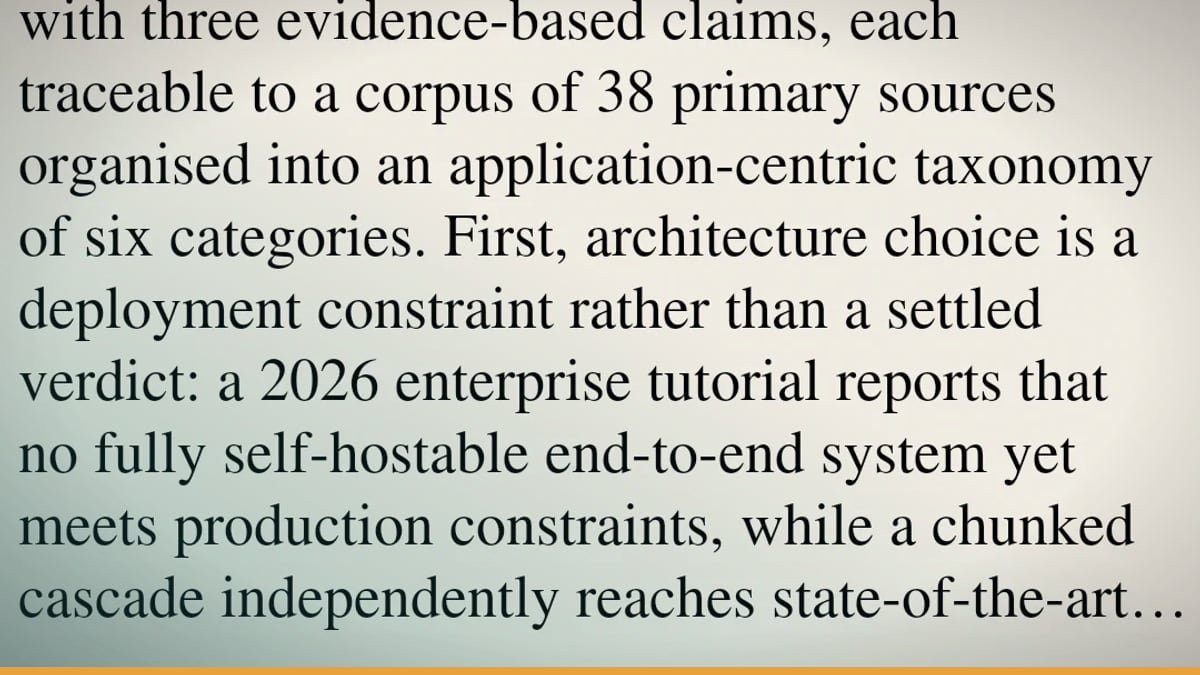
The paper addresses the evaluation gap with three evidence-based claims, each traceable to a corpus of primary sources. These aren’t observations—they’re a roadmap for building voice agents that don’t just sound human but act human.
1. Architecture Is a Deployment Constraint, Not a Verdict
No fully self-hostable end-to-end system yet meets production constraints. Let that sink in. Enterprise deployments require trade-offs. Architecture choice involves deployment constraints. Not yet.
This isn’t a failure. It’s complexity. Voice agents aren’t static models. They’re dynamic systems interacting with bandwidth, compute, and privacy regulations. The taxonomy treats architecture as a choice, not a given. Want low latency? You might need a chunked cascade. Need full self-hosting? Prepare for trade-offs in quality.
2. Duplex Behavior Is Separable from Duplex Architecture
A chunked cascade architecture independently reaches state-of-the-art duplex behavior. You don’t need an end-to-end system for real-time back-and-forth. You can modularize components—speech recognition, turn-taking, response generation—and still get human-like interaction.
This matters. Duplex behavior isn’t a black box. It’s a set of levers. Need lower latency? Adjust the chunking. Need higher accuracy? Swap in a better model. The chunked cascade isn’t just a technical workaround. It’s permission to stop chasing monolithic architectures that don’t fit real-world constraints.
3. Evaluation Is Shifting to Grounded Outcomes
Evaluation has shifted decisively from component quality toward grounded outcomes, with recent benchmarks verifying backend state rather than trusting what the agent says. This is the philosophical shift. Instead of trusting what the agent says, we’re checking what it knows.
Earlier evaluation approaches focused on different metrics. Grounded outcomes go further: they verify whether the agent’s internal state aligns with its spoken response. Did it retrieve the right information? Did it update its understanding of the conversation? This is how humans evaluate each other—not just by words, but by intent.
The paper organizes sources into an application-centric taxonomy of categories.
- Categories include aspects of voice agent evaluation.
- Categories include aspects of voice agent evaluation.
- Categories include aspects of voice agent evaluation.
This isn’t incremental. It’s a fundamental rethink.
Architecture Isn’t One-Size-Fits-All: The Chunked Cascade Breakthrough
The chunked cascade deserves its own section. Here’s why: you don’t need an end-to-end system for duplex behavior. You can break the pipeline into chunks—speech recognition, turn-taking prediction, response generation—and optimize each independently.
Why does this matter? Production use cases demand control. A customer service agent might need ultra-low latency but can tolerate slightly lower accuracy. A medical assistant might need high accuracy but can tolerate higher latency. The chunked cascade lets you allocate resources where they matter.
Production use cases require fine-grained resource allocation where coverage, complexity, and quality are independently controllable variables, not just ‘more data’. The chunked cascade delivers that control. It’s not a silver bullet—you still need to tune each component—but it’s a framework for making trade-offs deliberately.
There’s a catch. Synthetic data generation often lacks the rigor needed for production-scale voice agents. Current synthetic data generation methods often lack the rigor required for production-scale deployment. Synthetic data is the lifeblood of training these systems. If it doesn’t mirror real human interaction, the agent fails in production.
Improved methods are needed for synthetic data generation. Better synthetic data generation methods are needed for production-scale deployment. That’s the only way to build datasets that train agents for real conversations.
From Component Metrics to Grounded Outcomes: The Evaluation Revolution
The shift from component metrics to grounded outcomes isn’t just academic. It’s happening in industry. Hugging Face and Cerebras are deploying Gemma 4 for real-time voice AI. Benchmarks like Real World VoiceEQ measure human-like quality, not just technical metrics.
Grounded outcomes look like this:
- Benchmarks verify backend state rather than trusting what the agent says. Did it remember context? Did it retrieve the right information?
- Task success is one aspect of evaluation. A customer service agent might need to handle queries efficiently without errors. Different use cases have different requirements.
- Human quality of voice AI is measured by benchmarks. Multiple aspects contribute to human-like quality.
This mirrors the evolution of LLMs. Early benchmarks measured perplexity and token accuracy. Today, we evaluate LLMs in real-world chat scenarios—context handling, information retrieval, natural interaction. Voice agents are finally catching up.
The shift in evaluation mirrors broader trends in AI assessment.
The Missing Piece: Synthetic Data’s Role in Production Rigor
Synthetic data is the elephant in the room. Current methods often lack the rigor required for production-scale voice agents. Current synthetic data generation methods often lack the rigor required for production-scale deployment. Synthetic datasets that don’t capture real-world conversational dynamics are insufficient for production-scale deployment.
Current synthetic data generation methods often lack the rigor required for production-scale deployment of real-time voice agents. Improved methods are needed for synthetic data generation. Better synthetic data generation methods are needed.
Here’s what that looks like:
- Simulated conversations should include various conversational dynamics. Not just clean, single-speaker dialogues.
- Simulated conversations should include various conversational dynamics. Real conversations often involve topic changes.
- Simulated conversations should include various conversational dynamics. A voice agent must recognize and respond to these cues.
This isn’t about quantity. It’s about quality. The best synthetic datasets won’t be the largest. They’ll be the ones that capture real conversation unpredictability.
What This Means for Deployments: A Checklist for Builders
The paper’s taxonomy provides a framework for evaluating voice agents. Here’s what it means for builders.
For Engineers: Modularity Is Your Friend
- Use a chunked cascade to decouple duplex behavior from end-to-end systems.
- Allocate resources according to deployment constraints and use case requirements.
- Treat architecture as a deployment constraint. There’s no one-size-fits-all.
For Product Teams: Grounded Outcomes Drive Evaluation
- Benchmarks should verify backend state, not just outputs.
- Measure multiple aspects of voice agent performance.
- Synthetic data generation methods need improvement for production-scale deployment.
For Researchers: Synthetic Data Needs a Rethink
- Current synthetic data generation methods often lack the rigor required for production-scale deployment.
- Improved methods are needed for synthetic data generation.
- The goal isn’t more data—it’s better data.
The next wave of voice agents won’t be judged by how well they speak, but by how well they understand. That requires rethinking evaluation from the ground up.
The Road Ahead: Where the Fragmentation Persists
The gaps aren’t gone. They’re just being managed. Here’s what’s still missing.
No Fully Self-Hostable End-to-End System
No fully self-hostable end-to-end system yet meets production constraints. That’s not a failure—it’s a sign of maturity. Voice agents are complex enough to require bespoke solutions. The chunked cascade is progress, but we’re far from plug-and-play.
Synthetic Data’s Limitations
Can synthetic data ever replace human evaluation? Probably not. Improved synthetic data generation methods are needed.
Scaling Grounded Outcomes Benchmarks
Will grounded outcomes scale to niche use cases? Different use cases have different requirements. The taxonomy provides a framework, but domain-specific benchmarks may be needed.
Regulatory Pressures
How will GDPR, AI safety regulations, and privacy laws reshape evaluation? Voice agents often handle sensitive data. Grounded outcomes benchmarks will need to account for compliance, not just performance.
The fragmentation isn’t gone. But for the first time, we’re asking the right questions. The real win isn’t that we’ve solved the problem—it’s that we’re finally measuring voice agents like humans would. And that’s a breakthrough.