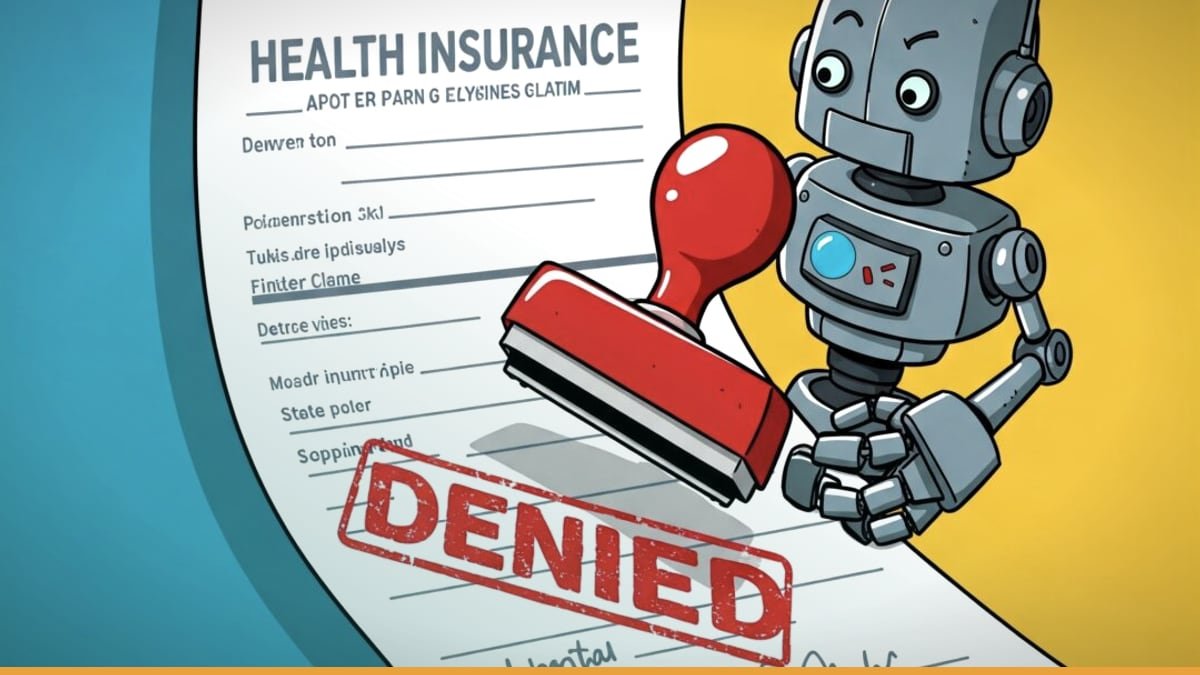
Header image source: Insurers Continue AI Claims Automation Despite Legal Challenges – Caroline Fife M.D. via Caroline Fife M.D. via Google — cropped to 16:9 and colour-adjusted.
Key takeaways
- BCBS analysis shows $942M in AI-driven healthcare cost inflation over two years
- AI coding tools maximize revenue through secondary condition billing
- Fee-for-service incentives create an AI arms race between hospitals and insurers
That date should be burned into every healthcare executive’s calendar. Because on that day, Blue Cross Blue Shield Association released an analysis. The analysis found $942 million in additional spending over two years, directly tied to AI-driven hospital billing practices. Not savings. Not efficiencies. Pure, unadulterated cost inflation. And it’s happening right now, in real time, across the U.S. healthcare system.
That $942 million isn’t a rounding error. It’s not a blip. It’s a structural shift in how hospitals generate revenue—and how insurers, employers, and patients foot the bill. The BCBS analysis, covering claims from 31 independent insurers and roughly 100 million enrollees, found that hospitals using AI coding tools drove up costs by $653 million through more frequent billing for secondary conditions alone.
This isn’t some theoretical risk buried in a white paper. It’s a real-world, billion-dollar problem. And if the incentives don’t change, it’s only going to get worse.
The $942 Million Surprise: What the Blue Cross Data Actually Reveals
Let’s break down the numbers. $942 million in additional spending over 2024–2025. Of that, $653 million comes from hospitals billing more frequently for secondary conditions. These aren’t incidental findings. They’re conditions that, when coded as present on admission, trigger higher Diagnosis-Related Group (DRG) payments under Medicare and private insurer reimbursement models.
The BCBS report doesn’t name specific AI tools, but the timeline aligns with the rapid adoption of generative AI in hospital operations. What the BCBS data suggests is that they’re also automating something else: revenue maximization.
Here’s the kicker. The report doesn’t link this $942 million to better patient outcomes. No evidence that sicker patients are being identified earlier. No data showing improved care coordination. Just higher bills. That’s not efficiency. That’s inflation, plain and simple.
The scope of the analysis is massive—100 million enrollees—but it’s not exhaustive. BCBS doesn’t disclose which hospitals or AI tools were included. It doesn’t show how their coding practices differ from pre-AI baselines. And it doesn’t prove whether the additional billing correlates with clinical necessity. That’s a gaping hole. Without transparency, it’s impossible to know whether this is a systemic issue with AI coding tools or just aggressive billing by a subset of providers.
But let’s be clear: even if it’s just a subset, $942 million is still a problem. A big one.
How AI Coding Tools Work—and Why They’re a Game-Changer for Billing
AI coding tools aren’t magic. They’re large language models trained on millions of historical clinician notes and claims data. Here’s how they operate:
- Real-time analysis: As a clinician dictates or types notes, the AI parses the text for keywords, symptoms, and diagnoses.
- Code generation: The tool auto-generates ICD-10 and CPT codes, often suggesting additional codes for comorbidities or complications that a human coder might miss.
- Revenue optimization: The AI is trained on historical claims data, which means it’s optimized to maximize reimbursement—not clinical accuracy. If a code has historically led to higher payments, the AI will suggest it.
Before AI, human coders relied on structured documentation, which led to two problems: undercoding (lost revenue) and overcoding (audit risks). AI solves the first problem but may be making the second worse. The BCBS data suggests that AI is flagging secondary conditions more aggressively, and insurers are paying for it.
The incentive problem is baked into fee-for-service reimbursement. Hospitals are paid more for sicker patients, so AI tools trained on historical claims data will naturally suggest codes that maximize payments. It’s not fraud. It’s optimization. And it’s perfectly legal—until an insurer pushes back.
The Hospital Counterargument: Are Insurers Just Mad They’re Losing?
Hospitals aren’t taking this lying down. Hospitals reply that they are finally being paid for care they already deliver, and that insurers run AI of their own.
The AHA’s argument isn’t without merit. Insurers do use AI to auto-deny claims. Hospitals, in turn, use AI to preempt denials by coding more defensively—adding secondary conditions, documenting complications, and generally making claims harder to reject.
This is the AI arms race in healthcare. Insurers deploy AI to deny claims. Hospitals deploy AI to justify them. Patients get stuck in the middle. The BCBS report doesn’t quantify this dynamic, but it’s implicit in the escalation. The $942 million isn’t just a cost increase. It’s a symptom of a system where both sides are using automation to game the other.
And here’s the kicker: there’s no neutral referee. The Centers for Medicare & Medicaid Services (CMS) audits human coders for upcoding, but AI-generated codes operate in a regulatory gray area. If an AI suggests a code and a clinician approves it, who’s responsible? The hospital? The AI vendor? CMS hasn’t weighed in—yet.
The Broader Trend: AI as a Multiplier of Existing Healthcare Frictions
This isn’t a new fight. Hospitals and insurers have been battling over billing for decades. What’s new is the scale. AI doesn’t just automate existing conflicts—it amplifies them.
Before AI, a human coder might handle dozens of claims per day. An AI tool can recode thousands. That means a single hospital can generate millions in additional revenue in weeks, not years. Insurers, in turn, can auto-deny claims at scale, leading to more disputes, more appeals, and more administrative waste.
The BCBS report doesn’t quantify this feedback loop, but it’s easy to imagine:
- Hospitals deploy AI coding tools → insurers pay more.
- Insurers raise premiums to cover costs → employers and patients pay more.
- Insurers deploy AI denial tools → hospitals invest in more aggressive AI coding.
- Rinse and repeat.
This is the automation trap. AI doesn’t solve inefficiencies. It scales them. And in a fee-for-service system, scaling inefficiencies means scaling costs.
Who Pays? The Hidden Costs of AI-Driven Billing Inflation
The $942 million isn’t just a number on a balance sheet. It’s a cost that gets passed down. Here’s how:
- Insurers: BCBS companies can’t absorb $942 million without raising premiums.
- Employers: Higher premiums mean higher costs for self-insured companies. That could lead to reduced benefits, higher deductibles, or lower wage growth.
- Patients: Higher deductibles and copays mean more out-of-pocket costs.
- Taxpayers: If private insurers pay more, Medicare and Medicaid may follow suit via higher reimbursement rates, increasing federal and state healthcare spending.
The care paradox is the most frustrating part. The BCBS report doesn’t link the $942 million to better outcomes. If AI-driven billing doesn’t correlate with improved health, it’s pure cost inflation. That’s not innovation. It’s a tax on patients.
What’s Next? Regulatory, Market, and Technical Fixes
The BCBS report doesn’t offer solutions, but the implications are clear. Here’s where things could go:
Regulatory Options
- CMS audits: Require AI-generated codes to be flagged for review, similar to human coder audits. If an AI suggests a secondary condition, CMS could mandate clinical justification.
- Transparency rules: Mandate disclosure of AI tools’ training data and coding logic. If hospitals use AI to generate codes, they should have to explain how those codes are derived.
- Incentive realignment: Shift reimbursement models to reduce fee-for-service gaming. Value-based care, bundled payments, and capitation all reduce the incentive to upcode.
Market Solutions
- Insurer counter-AI: Develop tools to detect AI-generated "upcoding" patterns. If a hospital’s claims suddenly include more secondary conditions after deploying AI, insurers could auto-deny those codes.
- Provider pushback: Hospitals may resist insurer AI denials, leading to more lawsuits.
Technical Fixes
- Explainable AI: Tools that justify coding decisions with clinical evidence, not just historical claims data. If an AI suggests a code, it should point to the specific note or lab result that supports it.
- Bias mitigation: Train AI on audited claims data to reduce overcoding tendencies. If an AI is trained on claims that were later denied, it’s less likely to suggest aggressive codes.
The Big Picture: Is AI in Healthcare a Feature or a Bug?
The optimism around AI in healthcare is real. AI could streamline prior authorization, reduce clinician burnout, and improve care coordination. But the BCBS report suggests that, in the short term, AI is doing the opposite: automating waste upward.
This isn’t just a technical failure. It’s a structural one. AI tools are optimized for billing complexity because that’s what fee-for-service reimbursement rewards. Until those incentives change, AI will continue to inflate costs.
The bigger question is whether this is temporary or permanent. Is the $942 million a "learning curve" effect—something that will stabilize as insurers adapt—or is it the new normal? The brief doesn’t say, but the trend isn’t encouraging.
Healthcare may be the first industry where AI’s financial externalities become too large to ignore. If regulators and policymakers don’t act, the AI arms race between hospitals and insurers will keep escalating. And patients will keep paying the price.
What to Watch in the Coming Months
This story isn’t over. Here’s what to monitor:
- CMS’s next move: Will the agency issue guidance on AI coding tools in 2027? If so, will it focus on transparency, audits, or reimbursement changes?
- Insurer lawsuits: Expect BCBS or other payers to sue hospitals over AI-driven upcoding. The legal theory could involve billing patterns enabled by automation.
- Hospital adoption rates: Are smaller providers deploying AI tools, or is this limited to large health systems? If it’s the latter, the cost inflation could be concentrated in a few players.
- Patient pushback: Will rising costs lead to backlash against AI in healthcare? Phrases about AI increasing insurance costs could become a rallying cry.
- International comparisons: Are other countries seeing similar AI-driven cost inflation? If this is a U.S.-specific problem, it points to fee-for-service reimbursement as the root cause.
The BCBS report isn’t just another skirmish in the hospital-insurer wars. It’s the first hard evidence that AI, deployed to streamline healthcare, is instead functioning as a revenue amplifier. The question isn’t whether this trend will continue. It’s whether anyone can stop it. And if not, what happens when the next billion-dollar side effect hits?
Sources
- Insurers claim AI is already increasing healthcare costs
- Insurers Claim AI Is Already Increasing Healthcare Costs
- AI Already Increases Healthcare Costs, Insurers Claim
- AI tools generated nearly $1 billion in extra costs, Blue Cross insurers say
- Battle of Hospital A.I. vs. Insurer A.I. Is Pushing Medical …
Leave a Reply