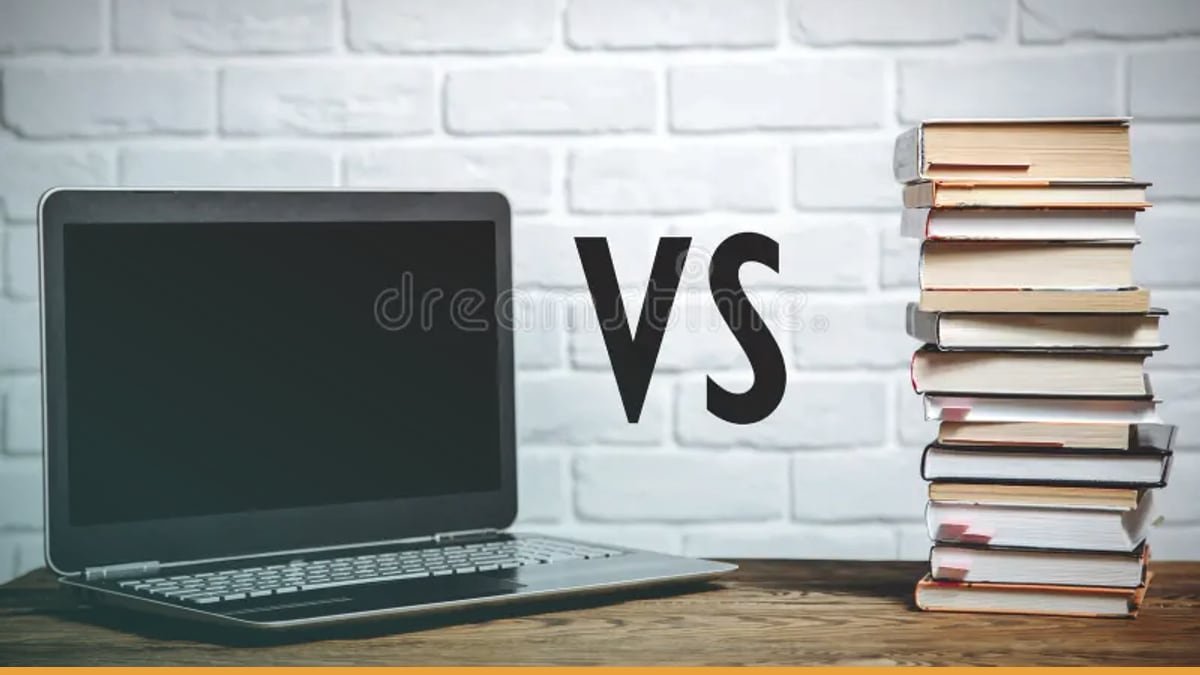
Header image source: 242 Technology Vs Books Stock Photos – Free & Royalty-Free Stock Photos from Dreamstime via Dreamstime via Google — cropped to 16:9 and colour-adjusted.
Key takeaways
- Technology provides speed and access but risks fragmentation
- Books foster deeper engagement and retention
- Educators face tension between policy mandates and classroom realities
Here’s the thing: nobody’s actually winning this fight. Technology delivers speed, convenience, scale—books deliver depth, retention, focus. That’s the trade-off. The real question isn’t which one to crown. It’s when to reach for each.
Computers haven’t killed books. Not even close. The evidence keeps showing books foster deeper engagement while screens risk fragmentation—skimming over reading, multitasking over thinking. That tension isn’t fading. If anything, it’s sharpening as classrooms push more screens while teachers quietly keep the paperbacks on the shelves.
Technology’s Case: Fast, Cheap, Everywhere
“Significantly transformed our lives.” That’s not hype. A single tablet holds thousands of textbooks, research papers, multimedia. Instant access to global libraries isn’t a luxury anymore—it’s baseline.
Digital tools enable learning that static textbooks can’t touch. Simulations, adaptive quizzes, embedded videos, collaborative annotation—these aren’t gimmicks. In STEM, interactive models of molecular structures or real-time data visualisations make abstract concepts tangible. A student can rotate a 3D DNA helix or tweak variables in a physics simulation in ways a printed diagram never could.
Convenience is technology’s biggest win. No more heavy backpacks. Remote learners get the same materials as classroom students. Search functions replace page-flipping. But convenience isn’t effectiveness. Faster doesn’t mean better. The question is whether the speed comes at the cost of comprehension.
Books’ Case: Quiet Resistance
Books aren’t just surviving—they’re stubborn. The criticism of technology’s “alienating” effects isn’t nostalgia. Studies suggest physical books reduce multitasking and cognitive load. When you read a book, you’re not switching tabs every 47 seconds. No notifications. No social media temptation. You’re doing what cognitive scientists call “deep reading”—sustained, linear attention that strengthens comprehension and retention.
This debate has dragged on for decades with zero evidence books will disappear. That’s telling. If books were truly inferior, they’d have vanished by now. Instead, universities still assign dense monographs. Writers still draft novels in notebooks. Researchers still cite printed journals. There’s a reason: books demand focus, and focus deepens learning.
Is technology’s “alienation” effect a design flaw or an inherent limitation? Some argue distraction is baked into digital interfaces—endless hyperlinks, autoplay videos, algorithmic feeds. Others believe better design could fix it. But even well-designed digital reading tools struggle to replicate the tactile, immersive experience of a physical book. The weight of a book in your hands, the progress marked by page numbers, no battery anxiety—these aren’t trivial. They shape how we engage.
Policy vs. Practice: The Teacher Backlash
There’s a “frustrating tension” between policy and practice. Policymakers push technology in classrooms, citing access, equity, future-readiness. Teachers resist. They see the trade-offs firsthand: students who skim instead of read, who struggle with long arguments, who multitask during lessons.
Educators keep asking how much technology is “enough.” The answer isn’t obvious. Some schools went 1:1 with devices, only to roll back when test scores stagnated or engagement dropped. Others banned screens entirely for younger students, citing developmental concerns. The inconsistency suggests we don’t know the optimal balance yet.
That’s not just philosophy—it’s practice. Group projects on shared documents can foster collaboration or enable free-riding. Digital discussion boards can democratise participation or flatten nuance. The same tool that connects students to global resources can disconnect them from the person next to them.
Are policymakers overestimating technology’s benefits while underestimating books’ value? The evidence isn’t clear, but the skepticism is. Teachers aren’t Luddites. They’re on the front lines, and they’re telling us screens aren’t a panacea.
The Attention Economy: How Screens Reshape Reading
Digital reading encourages skimming. That’s not opinion—it’s documented behavior. Eye-tracking studies show readers on screens spend less time per page, jump between sections more, retain less than print readers. The “F-shaped” reading pattern—scanning the first few lines, then skimming down the left side—is common on screens but rare in books.
Multitasking is another issue. A student reading a digital textbook might also be checking messages, browsing social media, listening to music. Each task switch incurs a “cognitive cost”—the brain needs time to reorient. Over time, this erodes the ability to sustain attention on a single task.
The “Battle of Ideas” event highlighted concerns about technology’s impact on focus and comprehension. The worry isn’t just distraction—it’s the kind of thinking technology encourages. Digital reading is often about efficiency: find the answer, move on. Book reading is about engagement: wrestle with ideas, make connections, linger on complex passages.
Does technology train students for quick information consumption rather than critical thinking? That’s the fear. If students spend more time skimming than reading, they may struggle with tasks requiring deep focus—writing a thesis, analysing a novel, solving complex problems. The risk isn’t that technology will replace books. It’s that it will replace the kind of thinking books demand.
The Hybrid Future: Matching Tools to Tasks
This debate won’t end soon, and that’s fine. Both tools will coexist because they serve different purposes. The challenge is figuring out when to use each.
Some subjects thrive on technology’s interactivity. STEM fields, for example, benefit from simulations, data visualisations, collaborative problem-solving. A biology student can explore a 3D cell model, manipulate variables in a genetics simulation, annotate a shared lab report with peers. These experiences are difficult, if not impossible, to replicate in a textbook.
Other subjects still rely on books. Literature, philosophy, history often require sustained attention to long-form arguments. A novel isn’t just information—it’s an experience. The pacing, the language, the structure demand focus. A digital version can deliver the text, but it can’t replicate the immersion of a physical book.
The optimal approach isn’t “either/or” but strategic integration. A history class might use digital archives for primary sources but assign printed books for analytical essays. A science class might use simulations for experiments but textbooks for foundational concepts. The key is matching the tool to the task.
The Unanswered Question: How Much Is Enough?
Educators still struggle with “how much technology is enough” in classrooms. No clear guidelines exist. Some schools mandate screen time; others limit it. Some teachers embrace digital tools; others avoid them. The inconsistency reflects broader uncertainty: we don’t yet know the long-term effects of technology on learning.
Are schools adopting technology out of necessity or proven effectiveness? Cost plays a role. Digital textbooks are often cheaper than printed ones, especially for cash-strapped districts. Access is another. Low-income students benefit from free digital resources. But convenience and cost aren’t educational impact.
The bigger question is whether technology is changing how students learn, not just how they access information. If screens encourage skimming and multitasking, are we training a generation of superficial thinkers? Or are we adapting to a new kind of literacy—one that prioritises speed and agility over depth and reflection?
The Stakes: What’s Really on the Line
This debate affects how students learn, retain, and engage with knowledge. That’s not hyperbole. The choices we make today will shape tomorrow’s thinkers.
If technology alienates students, it may undermine long-term learning outcomes. Distraction isn’t just a short-term problem—it can rewire attention spans. A student who spends years skimming digital texts may struggle with the sustained focus required for advanced study. The risk isn’t just lower test scores. It’s a generation less capable of deep work.
The real risk isn’t choosing wrong. It’s failing to adapt strategies as evidence evolves. The debate is valuable because it forces us to question assumptions. Are we prioritising convenience over comprehension? Speed over depth? Access over engagement? These aren’t abstract questions. They have real consequences for how students learn.
The debate isn’t over. That’s okay.
Neither technology nor books are universally superior. Each has strengths and weaknesses. Technology excels at speed, access, interactivity. Books excel at depth, focus, retention. The mistake is treating this as a binary choice.
Instead of picking sides, educators should focus on when and how to use each tool. A history class might use digital archives for primary sources but assign printed books for analytical essays. A science class might use simulations for experiments but textbooks for foundational concepts. The goal isn’t to replace books with technology or vice versa. It’s to leverage the strengths of each.
What kind of learners do we want to cultivate? What kind of thinking do we value? The answers aren’t obvious. But they’re worth pursuing. The future of learning isn’t about choosing between screens and pages. It’s about using both wisely—and asking why.
Leave a Reply