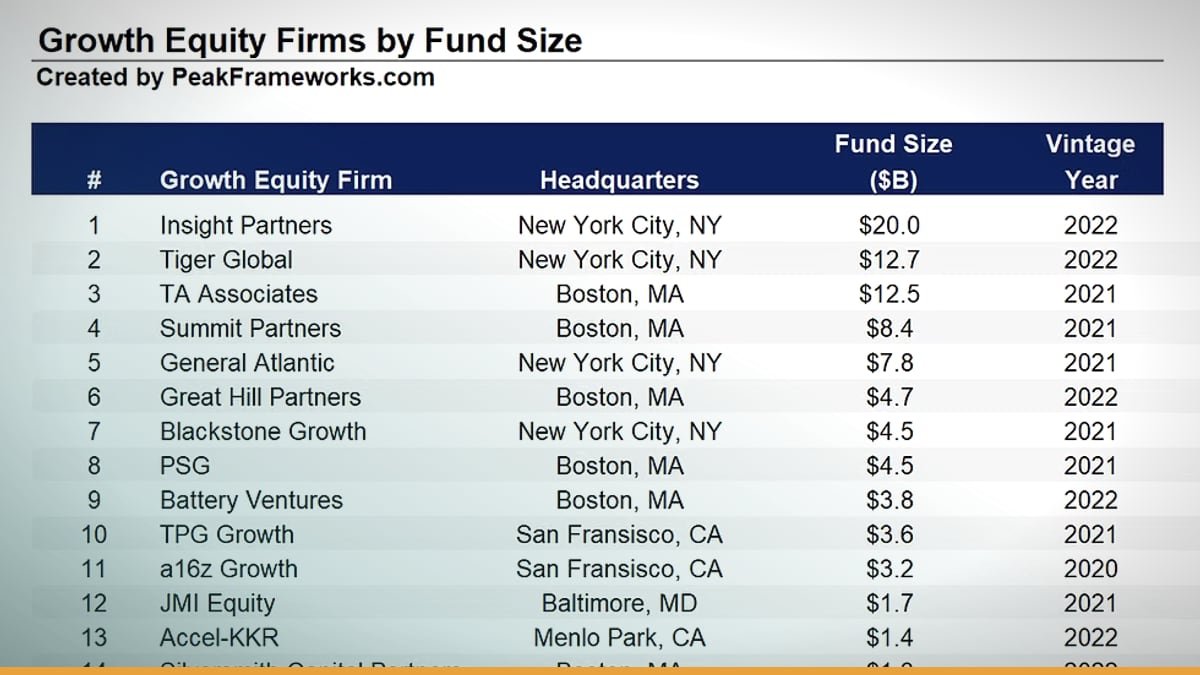
Header image source: What is Growth Equity? / Growth Equity Interview Guide via Peak Frameworks via Google — cropped to 16:9 and colour-adjusted.
Key takeaways
- General Innovation Capital manages $331M for growth-stage deep-tech firms
- Targets companies at critical inflection points between R&D and mass adoption
- Focuses on quantum computing and advanced communications for Western tech leadership
General Innovation Capital has $331M in assets under management. Not venture. Not private equity. Growth equity—meaning it steps in when a deep-tech company has proven the science, cleared the regulatory hurdles, and now needs capital to scale. The firm’s pitch? It invests at the exact moment a technology hits its inflection point: when quantum computing stops being a lab experiment, when advanced communications moves from R&D to deployment, when deep tech shifts from niche to necessity. This isn’t innovation as inspiration. It’s innovation as institutional-grade capital, deployed with precision to reinforce Western technological leadership.
They target companies at "critical inflection points"—the moment when a technology moves from experimental to essential. That’s not early-stage VC. That’s growth equity, a discipline that sits between the high-risk world of venture and the cash-flow stability of private equity. The distinction matters. General Innovation Capital isn’t betting on ideas. It’s betting on momentum.
The Inflection Point: Why Timing Is Everything
The firm’s entire thesis hinges on one idea: breakthrough technologies only scale when they hit an inflection point. This isn’t theoretical. It’s a testable claim, and their strategy is built on spotting these moments before they become obvious.
For decades, it was a lab curiosity—promising, but commercially irrelevant. Quantum computing has progressed from lab curiosity to commercial relevance. They mark the shift from “will this ever work?” to “how fast can we scale it?” General Innovation Capital’s focus on advanced technology suggests they’re betting on transitions from experimental to commercial viability.
They’re targeting technologies moving from R&D to deployment. Again, the inflection point is the key. It’s the difference between a prototype and a product with a market.
This isn’t just about picking winners. It’s about timing. Their growth equity approach avoids the early-stage risk of traditional venture capital. Instead, they look for companies that have cleared technical and regulatory hurdles but haven’t yet achieved mass adoption. This is where institutional clients want to deploy capital: in opportunities that are de-risked but still high-growth.
The Sectors: Where the Firm Puts Its Money
Areas include quantum and advanced communications. They’re technologies that align with Western strategic priorities.
Quantum computing is a national priority. The technology’s applications could redefine entire industries. There is international competition in quantum computing. General Innovation Capital’s focus suggests they see advanced technologies as strategic imperatives.
Advanced communications focuses on next-generation networks. These are technologies critical for both economic competitiveness and national security. The firm’s interest aligns with trends like the U.S. push to diversify supply chains away from Chinese telecom equipment.
It refers to hardware or software enabling breakthroughs in other fields. The inclusion of "impact & social enterprise" suggests a focus on technologies with societal benefits.
They’re betting on technologies that can reshape industries and economies.
The Institutional Angle: Who Benefits?
It’s built for institutions that have both the capital and patience for high-growth, high-impact sectors. Their $331M AUM and 2024 SEC registration signal institutional focus.
Their strategy is designed for institutional clients.
It suggests they work with institutional partners. By acting as an advisor, they can leverage technical expertise.
It implies clients are investing in technologies that reinforce Western resilience.S. and allied leadership. This aligns with trends in technology policy.
The Geopolitical Layer: Why “Western Resilience” Matters
It reflects a recognition that technological leadership has strategic importance. There is international competition in next-generation technologies. General Innovation Capital’s strategy suggests they see themselves as part of technological advancement.
The technology has significant implications for security. There are efforts to protect technological advantages. General Innovation Capital’s focus here suggests they’re betting on companies that can help the U.S. maintain its lead—or avoid falling behind.
There are efforts to reduce reliance on foreign technology. The next frontier of communications will be critical. The firm’s interest implies a belief that the U.S. The firm’s interest implies a belief that Western countries can build competitive technologies.
Their U.S.-based footprint reinforces this angle. Unlike global VC firms, General Innovation Capital keeps investments close to home. This could reflect a strategy to align with Western policy priorities.
The question is whether this is defensive or offensive in nature. It will shape technological leadership for decades.
The Mechanics: How They Operate
General Innovation Capital’s inflection-point focus sets them apart. They target companies at critical inflection points of growth. This is where identifying inflection points comes into play.
Quantum computing is progressing through different stages of development. The next inflection point involves more advanced quantum capabilities. This is when technologies move from experimental to commercial. Their strategy suggests they’re betting on companies at inflection points.
Their focus on both financial returns and Western resilience adds complexity. The brief mentions "impact & social enterprise," but it’s unclear what specific areas this covers. If it’s the latter, their impact metrics might include patents filed, U.S. jobs created, or supply chain diversification—measures aligning with national priorities.
The inflection-point focus requires active engagement. Their venture-capital advisory model suggests they work with institutional partners.
What General Innovation Isn’t
The inflection-point focus demands active engagement. They bet on companies at critical growth moments.
It’s a structured investment strategy blending financial returns with strategic impact. Their target sectors—quantum, advanced communications, deep tech—are important for technological advancement.
The Broader Trend: Why This Model Is Here to Stay
Growth equity is rising, with firms focusing on later-stage, high-growth opportunities. Deep tech is attracting more investment.
Some firms blend commercial and strategic goals.S. leadership. General Innovation Capital serves institutional clients.
Some sectors have become priorities for institutional investors. General Innovation Capital’s focus suggests they see opportunities in advanced technology sectors.
Their $331M AUM is significant.
The Unanswered Questions
How do they measure “Western resilience”? Patents filed? Jobs created? Supply chain diversification? Or something more nebulous, like geopolitical influence?
How do they differentiate from other firms that focus on deep tech?
The Biggest Question: Can General Innovation Scale?
The sectors they target have long time horizons. Institutional clients are interested in both strategic narratives and returns.
It will be a template for how institutional capital deploys in advanced technology.
Sources
- General Innovation Capital Partners
- General Innovation Capital investment portfolio
- General Innovation Capital: Funding, Team & Investors
- General Innovation Capital | MTEC
- General Innovation Capital, LLC – $331M AUM
- How to pitch General Innovation Capital
- General Innovation Capital Partners — Investor profile
- About Us – Welcome to General Innovation Llc
Leave a Reply